 One Spot Home
Where to Start Decluttering When You Feel Overwhelmed
Start with one small spot you see every day, like the kitchen counter, the entryway table or the chair that collects clothes. Set a timer for 15 minutes and take out the trash first. Don’t start with the garage, the junk drawer or the box of old photos. You want a first win you can see, and you want it today.
Below: why this works, a script for your first 15-minute session, what to do when you’re stuck on an item, and five well-known methods compared.
 Save to Pinterest
The short answer: where to start decluttering
- Where: a spot you see every day. Dana K. White calls this the Visibility Rule.
- How big: one shelf, not the whole closet. Marla Cilley (FlyLady) suggests you “just pick a spot”.
- How long: 15 minutes. That’s FlyLady’s daily unit.
- What first: trash, then things that already have a home somewhere else. These are the first two of Dana K. White’s 5 steps for working through an overwhelming mess.
- What to leave for later: hidden storage (closets, drawers, the attic) and sentimental items. Marie Kondo puts sentimental items last in her order.
Why starting small and visible works
It’s tempting to fix the “worst” room first, but that’s usually the biggest job and the hardest to decide on.
Visible spots give you visible progress. Dana K. White explains her Visibility Rule this way: decluttering a hidden space like a junk drawer or a closet won’t change how your home looks, so you don’t get the boost that keeps you going. A clear kitchen counter is something you’ll notice every time you walk past it.
Small spots make it possible to finish. FlyLady’s advice is to pick one shelf instead of the whole closet and to work in 15-minute blocks. You end the session with a finished area, not a half-emptied room that looks worse than when you started.
Easy decisions first. Marie Kondo starts with categories that are easier to decide on and leaves sentimental items for the end. Her reasoning is that you practice making decisions before you face the hard ones.
About clutter and stress: a 2010 study by Saxbe and Repetti looked at 60 people in dual-income marriages. Over three weekdays, wives who described their homes with more “stressful” words (clutter, a home that felt unfinished) had a flatter daily cortisol pattern (PubMed). It was a small study and it found a correlation, not proof that clutter causes stress. It doesn’t show that decluttering lowers stress, so treat it as background, not as a promise.
If you can’t let go of anything at all, or the clutter is affecting your health, safety or relationships, an article isn’t the right tool. Talking to a doctor, a therapist or a professional organizer is a better first step.
Your first 15-minute decluttering session, step by step
This script combines Dana K. White’s 5 steps with FlyLady’s 15-minute timer. You don’t need to buy anything.
Before you start (2 minutes)
- Pick your spot: small and visible. A counter, a nightstand, one bathroom shelf.
- Grab a trash bag and a box for donations.
- Set a timer for 15 minutes.
During the session
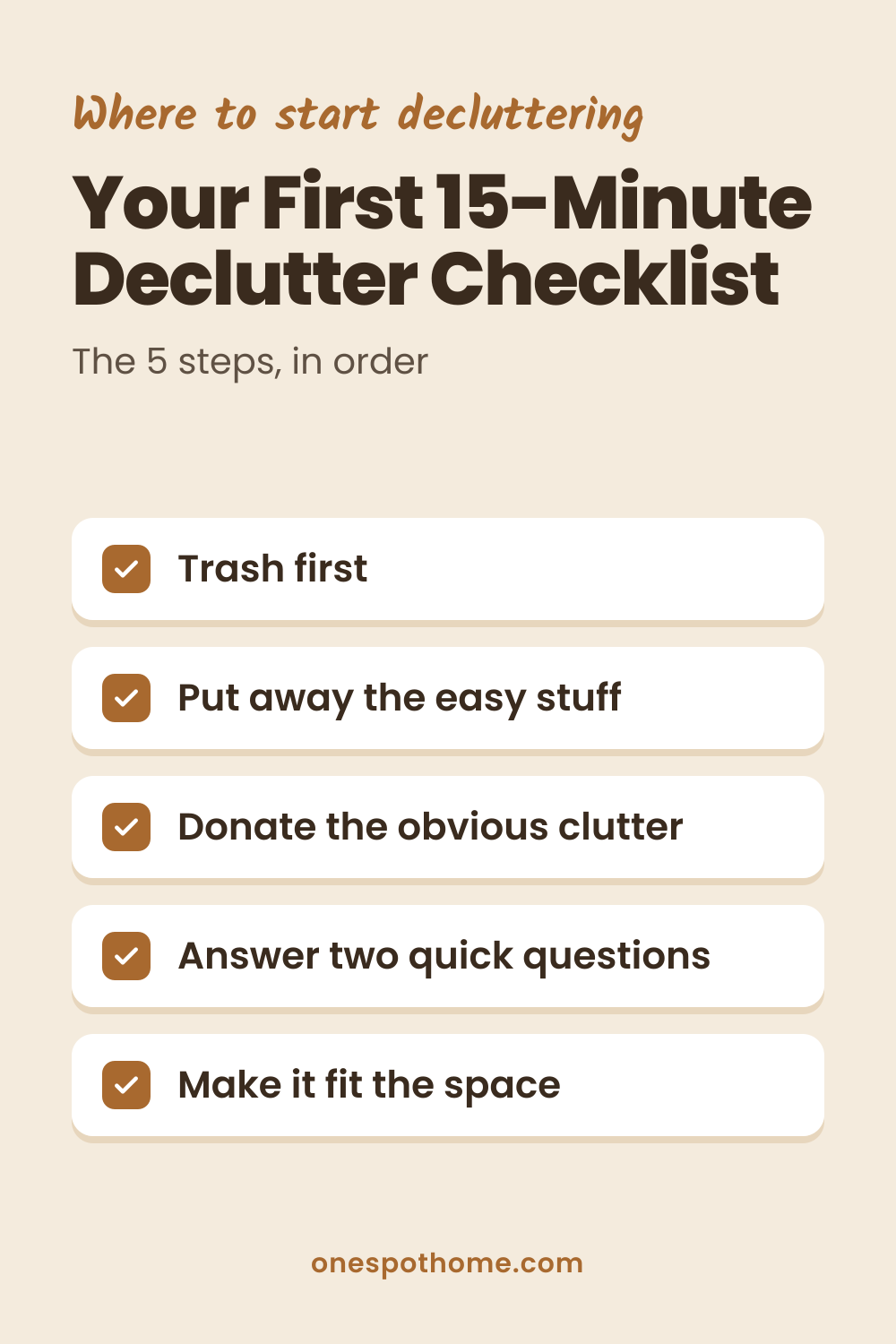
- Trash. Dana K. White’s first step: “Starting with the most visible mess, remove trash.” Wrappers, junk mail, empty packaging, dried-up pens. No decisions needed.
- Easy stuff. In her words, this is “stuff that has an established home somewhere else but for whatever reason isn’t there.” The mug goes back to the kitchen, the scissors go back to the drawer. Put each thing away right now instead of making a “to put away” pile.
- “Duh” clutter. Her term for the obvious stuff, which goes straight into the donation box. Our reading of the name: things you know you don’t want the moment you look at them.
- The two decluttering questions. For whatever is left, ask the questions in the box below.
- Make it fit. Dana K. White calls this the Container Concept. The space (the shelf, the drawer, the counter) is the limit. Group similar things together, then keep only as many as fit.
When the timer goes off
Stop, even if you’re not done. Take the trash out, and put the donation box somewhere it will actually leave the house, like by the front door or in the car. Tomorrow, do another 15 minutes on the same spot or the one next to it.
 Save to Pinterest
When you’re stuck on one item
Use whichever of these questions gets you unstuck.
Dana K. White’s two decluttering questions (from her 5-step PDF):
- “If I needed this item, where would I look for it? Take it there now.”
- “If I needed this item, would it occur to me that I already had one?”
Our reading of the second question (not Dana K. White’s words): if you’d forget you own something, you probably wouldn’t use it when the need came up.
The Minimalists’ 90/90 rule (source): have you used it in the last 90 days? Will you use it in the next 90? If not, it’s okay to let it go. They say you can adjust the time window to fit your life.
The Minimalists’ 20/20 rule (source) is for “just in case” items: “Anything we get rid of that we truly need, we can replace for less than $20 in less than 20 minutes from our current location.” The authors themselves say it works for most items and most people, not all. If replacing something would be a real strain on your budget, or you live far from stores, this rule may not fit you.
Still undecided? Put the item back and move on. You’re building a habit, and one item shouldn’t eat your whole 15 minutes.
Which decluttering method fits you? 5 methods compared
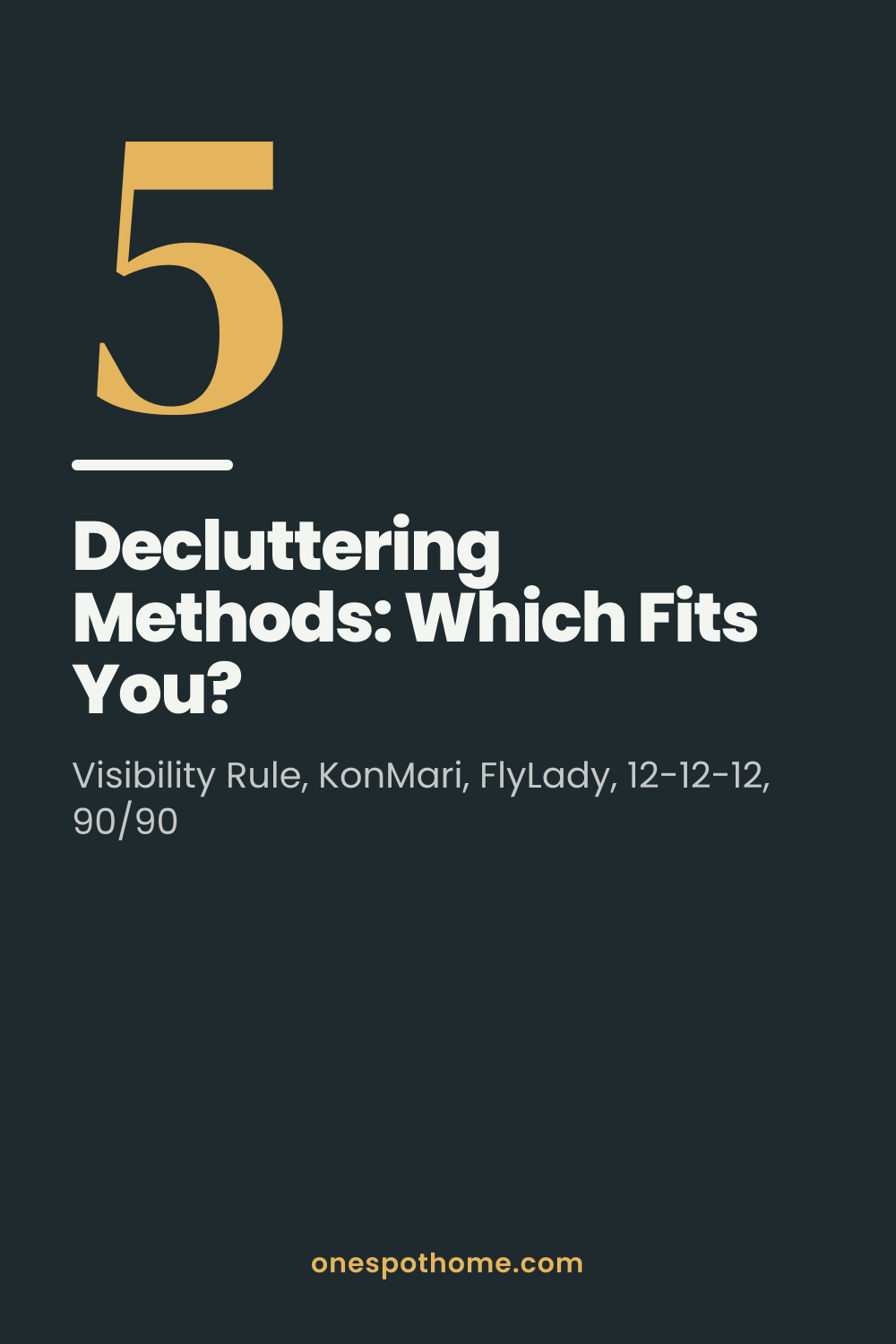
There’s no single “right” method. The “Source” column shows where each method is described. The “good fit if” and “watch out for” columns are our own summary, not the authors’ words.
| Method | Source | How it works | Good fit if… | Watch out for… |
|---|---|---|---|---|
| Visibility Rule + 5 steps | Dana K. White (A Slob Comes Clean) | Start with the most visible mess. Trash → easy stuff → donate → two questions → fit the space | You feel overwhelmed and have only short, interrupted blocks of time | It works spot by spot, so the whole house takes a while |
| Category order (KonMari) | Marie Kondo (konmari.com) | Work by category, not by room: clothes, books, papers, komono (miscellaneous), sentimental items last | You can set aside larger blocks of time and want to go through everything once | Working one category across the whole house is a bigger commitment than one shelf |
| 15 minutes a day + 27 Fling Boogie | FlyLady, Marla Cilley (flylady.net) | Pick one spot, work for 15 minutes a day. The 27 Fling Boogie: find 27 things to throw away and 27 to give away (as summarized on Wikipedia) | You want a small daily routine more than a big project | Progress feels slow if you’re hoping for a dramatic change |
| 12-12-12 challenge / Four-Box | Joshua Becker (as described on Becoming Minimalist) | 12-12-12: find 12 things to throw away, 12 to donate and 12 to put back where they belong. Four-Box: trash, give away, keep, relocate | You like a game or a clear target | Hitting a number isn’t the same as clearing a space. Pair it with one spot |
| 90/90 and 20/20 rules | The Minimalists (90/90, 20/20) | Decision rules for single items (see above) | You get stuck on “what if I need it?” | These are rules for deciding, not a plan for where to start. Combine them with one of the methods above |
If you’re not sure, a simple combination is: Dana K. White’s steps for the session, FlyLady’s 15 minutes for the timing, and The Minimalists’ rules when you’re stuck. It’s also the approach used in the script above.
 Save to Pinterest
Where to start decluttering your home: is there a best room?
No room is the right one for everyone. The criterion is visibility and size, not the room. Good first spots:
- the kitchen counter or dining table
- the entryway (shoes, bags, mail)
- the coffee table or the nightstand
- the bathroom counter
- the “chair” (every home has one) where clothes pile up
Leave these for later, once decluttering feels routine:
- the garage, attic, basement and storage units
- closets and drawers you don’t see every day
- sentimental items: photos, letters, kids’ artwork, inherited things
Room by room or category by category? Marie Kondo works by category across the whole house; Dana K. White and FlyLady work one spot at a time. If you feel overwhelmed, one spot asks less of you to get started. You can switch to categories later, for example for your closet.
How to start decluttering your house: a simple first week
This plan is our own synthesis of the methods above, not a program from any one author. Each day is one 15-minute session using the script above.
| Day | Where | Tip |
|---|---|---|
| 1 | Kitchen counter | Trash and easy stuff only are enough |
| 2 | Kitchen counter (finish) or dining table | Try the Container Concept: what fits on the counter? |
| 3 | Entryway | Mail, shoes, bags. Duh clutter goes in the donation box |
| 4 | Coffee table or nightstand | Use the two questions for anything you’re unsure about |
| 5 | Bathroom counter | Expired or empty products count as trash |
| 6 | The “chair” or one clothes pile | Put away what has a home. Question the rest |
| 7 | Take the donation box out of the house | Look back at the spots you’ve cleared |
After the first week, keep going with one spot a day.
Common mistakes when you’re just starting
- Buying storage bins first. With the Container Concept, the space you already have sets the limit. So it makes sense to declutter first and only buy containers if you still need them.
- Pulling everything out at once. If you empty a whole closet and run out of time or energy, you’re left with a bigger mess. Working one small spot with a timer avoids this.
- Leaving the donation box in the house. Until it’s out the door, the stuff is still yours. Plan when it leaves, as in Day 7 above.
Quick recap
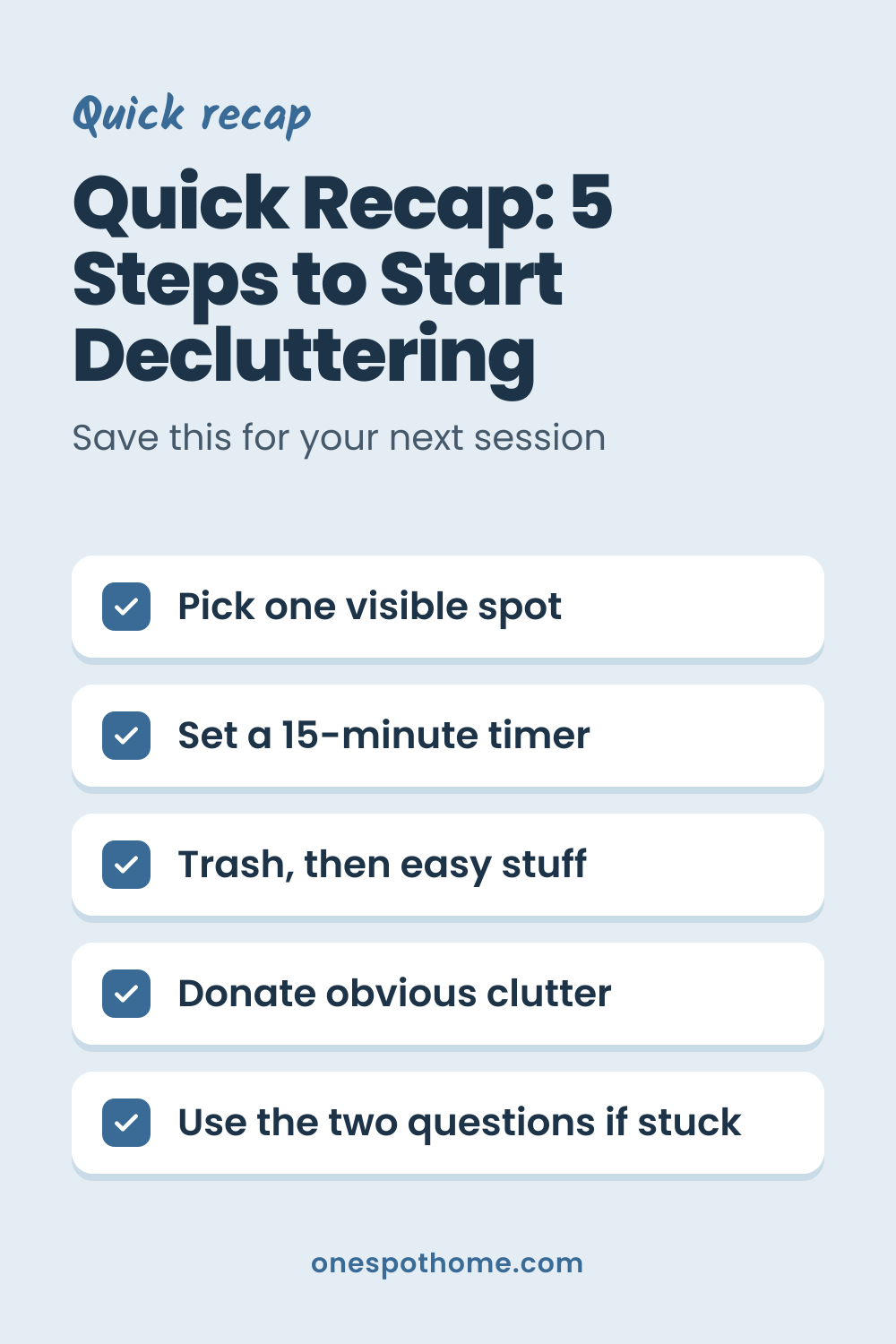
- Pick one small, visible spot.
- Set a timer for 15 minutes.
- Trash → easy stuff → donate → two questions → make it fit.
- Stop when the timer goes off, and get the trash and donations out.
- Repeat tomorrow, one spot at a time.
 Save to Pinterest
Sources
- Dana K. White, 5 Steps for Working Through an Overwhelming Mess (PDF), A Slob Comes Clean: https://www.aslobcomesclean.com/wp-content/uploads/2018/03/DASL-5-Steps-to-Working-Through-Mess.pdf
- Dana K. White, “The Visibility Rule,” A Slob Comes Clean: https://www.aslobcomesclean.com/2018/01/visibility-rule-important-decluttering/
- Marie Kondo, “Rule 5: Follow the Right Order,” KonMari: https://konmari.com/marie-kondo-rules-of-tidying-follow-order/
- FlyLady, “Where to Start DeCluttering,” FlyLady.net: https://flylady.net/ask-flylady/where-to-start-decluttering
- “FlyLady,” Wikipedia (secondary source for FlyLady being Marla Cilley and for what the 27 Fling Boogie involves): https://en.wikipedia.org/wiki/FlyLady
- Joshua Becker, “10 Creative Decluttering Tips,” Becoming Minimalist: https://www.becomingminimalist.com/creative-ways-to-declutter/
- The Minimalists, “The 90/90 Rule”: https://www.theminimalists.com/ninety/
- The Minimalists, “The 20/20 Rule” (Just in Case): https://www.theminimalists.com/jic/
- Saxbe & Repetti (2010), Personality and Social Psychology Bulletin (abstract on PubMed): https://pubmed.ncbi.nlm.nih.gov/19934011/