Decluttering Checklist: Room by Room, With Where Everything Goes
Pick one room, or one spot in it. Set a timer for 15 minutes and go down the list for that room. Sort each item into one of four places: trash, donate or sell, recycle, or special drop-off. That last group is for medicine, batteries, old electronics, paint and cleaners, and papers with personal information. Those tend to sit in a “deal with it later” box for months. So each one below gets a note on where it goes, with a link to the official guidance.
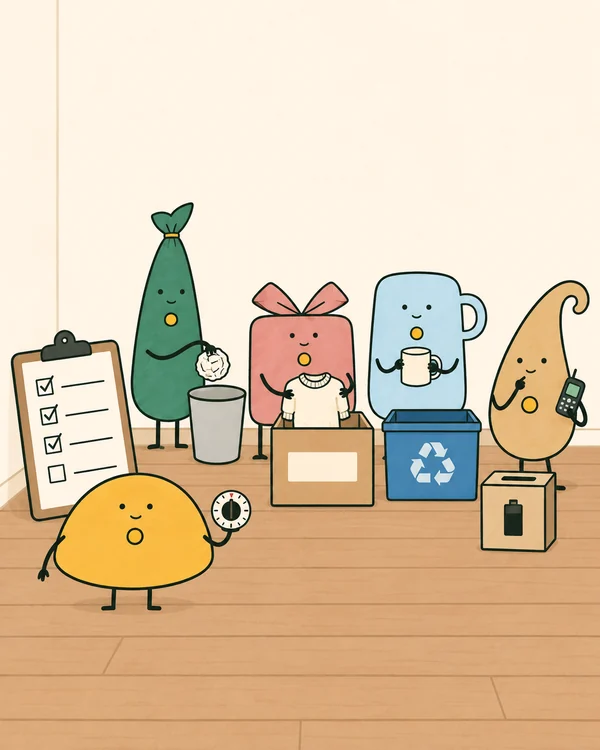
This declutter list by room is our own summary of the usual trouble spots, not a program from any one author. The disposal notes come from the FDA, EPA, FTC, IRS and USDA, and are linked where they appear.

How to use this checklist
Set up four spots before you start:
- Trash: a bag.
- Donate or sell: a box. Decide now when it leaves the house.
- Recycle: a bag or bin, following your local rules.
- Special drop-off: a small box for anything marked ⚠ in the lists below. Keep it out of kids’ and pets’ reach until it’s gone.
In each spot, work in this order. These are Dana K. White’s 5 steps for working through an overwhelming mess:
- Trash (“Starting with the most visible mess, remove trash”).
- Easy stuff, meaning things that have “an established home somewhere else.” Put them there now.
- “Duh” clutter goes in the donate box. That’s her name for the obvious stuff. Our reading: things you know you don’t want the moment you look at them.
- The two decluttering questions (see “When you’re not sure” below).
- Make it fit. She calls this the Container Concept: consolidate, then “purge down to the limits of the container.” The shelf or drawer is the limit.
Tick a box when a spot is done, not when the whole room is. A room can take several 15-minute sessions.
New to decluttering? Start with where to start decluttering, which has a script for your first 15-minute session.
Which room first?
You don’t have to follow the order of this page. Two well-known options:
- Start where you’ll see it. Dana K. White’s Visibility Rule: begin with a space you see every day, so the progress keeps you going.
- Follow a fixed rotation. FlyLady’s zones go: entrance, front porch and dining room; the kitchen; the main bathroom and one other room; the master bedroom; the living room. She asks for “15 minutes a day working on your zone for that week.”
The lists below roughly follow FlyLady’s order. Storage areas come last.
Entryway and dining table
- Mail and flyers you’ve already read → recycle (shred anything with personal information first, see Paper)
- Shoes nobody has worn this season → donate
- Bags, tote bags and reusable shopping bags beyond what fits on the hook → donate
- Keys you can’t match to a lock → trash
- Umbrellas that don’t open → trash
- Things that live in another room → put them away now
- Dining table: everything that isn’t meant to be on it → put away, trash or donate
Kitchen
- Duplicate utensils, spatulas, can openers → keep the ones you use and donate the rest
- Mugs and water bottles beyond what fits on the shelf → donate
- Food storage containers without lids (and lids without containers) → recycle if your program takes them, otherwise trash
- Chipped or cracked dishes → trash
- Gadgets you haven’t used in a year → donate or sell
- Takeout menus, sauce packets, extra plastic cutlery → recycle or trash
- Kitchen towels with holes → trash (or keep a few as rags)
- Counter: only what you use every day stays out
Pantry and fridge
- Open packages that have gone stale → trash
- Duplicates → group them together and use them up first
- Sealed food you won’t eat → donate (check what your local food bank accepts)
- Old spices, condiments and sauces → check them one by one
About the date on the package: USDA’s Food Safety and Inspection Service says that, except for infant formula, product dates are not required by federal law and are not a safety indicator. A “Best if Used By” date is about quality. The date alone won’t tell you whether to toss something. FSIS explains what each date means in its guide to food product dating.

Bathroom
- Empty bottles and near-empty samples → recycle or trash
- Hotel toiletries you’ll never use → donate (some shelters accept them, ask first)
- Old toothbrushes, worn-out loofahs → trash
- Hair tools you don’t use → donate or sell. If one has a built-in rechargeable battery, see ⚠ Electronics
- Towels with holes → trash, or ask a local animal shelter whether they take them
- ⚠ Expired or unused medicines → special drop-off. The FDA’s first choice is a drug take-back location or a prepaid mail-back envelope. If that isn’t available, the FDA says most medicines can go in the household trash: mix them with something unappealing like used coffee grounds, dirt or cat litter, seal the mix in a bag or container, and scratch out your personal information on the packaging. “Don’t flush your medicine unless it is on the flush list.” This is only about disposing of medicine you’ve already stopped using or that has expired. Whether to stop a medicine is a question for your doctor or pharmacist.
- Sunscreen → the FDA says a sunscreen without an expiration date “should be considered expired three years after purchase,” and to “discard expired sunscreens because they may not be safe and effective anymore.”
- Makeup → US law doesn’t require expiration dates on cosmetics, but the FDA notes that “manufacturers usually recommend discarding mascara two to four months after purchase.” It also says to throw mascara away if it dries out, and notes that heat, sunlight and air can change a product’s color and texture and make it smell.
Bedroom and closet
- Clothes that don’t fit you now → donate or sell
- Clothes with stains, holes or broken zippers you won’t fix → textile recycling if there’s a drop-off near you, otherwise trash
- Socks without a pair → trash or rags
- Hangers beyond what the closet holds → donate or recycle (check your program)
- Nightstand: old receipts, dead pens, empty product boxes → trash or recycle
- Books you’ve finished and won’t reread → donate
- Under the bed: open every bin and decide
- Bedding and pillows for beds you no longer have → donate if clean and in good shape
Living room
- Magazines and catalogs → recycle
- DVDs, CDs and games you don’t play → donate or sell
- Remotes for devices you no longer own → special drop-off (see ⚠ Electronics; take the batteries out)
- Throw pillows and blankets beyond what the sofa holds → donate
- Decor you keep moving around but don’t like → donate
- Coffee table: only what you use there stays
⚠ Electronics and the “cable drawer”
- Cables and chargers for devices you no longer own → special drop-off (electronics recycler)
- Old phones, tablets, laptops → before you donate or recycle, the EPA says to “delete all personal information” and to remove batteries, which “may need to be recycled separately”
- ⚠ Lithium-ion batteries and anything that contains one (old phones, power banks, small rechargeable gadgets) → the EPA says these “should NOT go in household garbage or recycling bins”. Tape the terminals or put each battery in its own plastic bag, and take them to a battery drop-off or household hazardous waste collection point. The EPA points to Earth 911 and Call2Recycle to find one.
- ⚠ Other loose batteries → special drop-off or your local household hazardous waste program (the EPA lists batteries among household hazardous waste). Rules vary by area, so check locally.
Paper and home office
The FTC has a simple guide to which documents to keep and which to shred. In short:
- Keep for one year: bank statements, pay stubs, undisputed medical bills, credit card and utility bills
- Keep three years or longer: income tax returns and tax-related documents (receipts, W-2s, 1099s), records related to selling a home
- Keep permanently, locked up: birth certificate or adoption papers, Social Security cards, valid passports, marriage licenses and divorce decrees, military records, wills and powers of attorney, retirement and pension plans
- ⚠ Shred: ATM receipts, offers of credit or insurance, credit reports, prescription information for medicines you no longer take, expired warranties, expired credit cards and IDs. No shredder? The FTC suggests looking for “a local shred day in your community.”
- Manuals for things you no longer own → recycle
- Dried-out pens and markers → trash
On tax records, three years is the IRS’s usual period, but it’s longer in some situations (for example, 6 or 7 years in specific cases, and property records until the period runs out for the year you sell). See the IRS page How long should I keep records? If you’re unsure, keep the tax papers and ask a tax professional.

Laundry room, garage and under the sink
- Empty containers → recycle or trash
- Tools you have two of → donate the extra
- Sports gear nobody uses → donate or sell
- Holiday decor you didn’t put up last year → donate
- ⚠ Leftover paint, cleaners, motor oil, pesticides → special drop-off. The EPA counts these as household hazardous waste and says not to pour them down the drain, on the ground or into storm sewers. Some shouldn’t go in the regular trash either. Contact your local solid waste agency about household hazardous waste collection days.
When you’re not sure about an item
Dana K. White’s two decluttering questions:
- “If I needed this item, where would I look for it? Take it there now.”
- “If I needed this item, would it occur to me that I already had one?”
Or The Minimalists’ 90/90 rule: have you used it in the last 90 days, and will you use it in the next 90? If not, it’s okay to let it go. They say you can change the time window to fit your life.
Still stuck? Put it back and move on. One item shouldn’t take up your whole 15 minutes.
A minimalist decluttering checklist (the short version)
If the full list feels like too much, these 10 items cover most homes. This short version is our own pick from the lists above.
- One bag of trash from the most visible spot
- Mail and paper on the counters
- Duplicate kitchen utensils
- Food storage containers without lids
- Expired medicines and sunscreen ⚠
- Clothes that don’t fit
- Socks without a pair
- Cables for devices you no longer own ⚠
- Loose batteries ⚠
- The donate box, out of the house
Make your own declutter list template
Your home won’t match these lists exactly, so make your own. Draw a table with these columns, one row per spot (not per room):
| Spot | Done | Trash | Donate/sell | Recycle | Special drop-off | Leaves the house on |
|---|---|---|---|---|---|---|
| Kitchen counter | ☐ | ☐ | ☐ | ☐ | ☐ | ________ |
| Bathroom drawer | ☐ | ☐ | ☐ | ☐ | ☐ | ________ |
| Entryway | ☐ | ☐ | ☐ | ☐ | ☐ | ________ |
The last column matters most. A donate box with no date usually stays in the house.
Quick recap
- Set up four spots: trash, donate/sell, recycle, special drop-off.
- Pick one room, or one spot in it, and set a 15-minute timer.
- Trash first, then easy stuff, then the rest.
- Medicines, batteries, electronics, paint, cleaners and personal papers go to the special drop-off, following the linked guidance.
- Take the trash out and give the donate box a date to leave.

Sources
- Dana K. White, 5 Steps for Working Through an Overwhelming Mess (PDF), A Slob Comes Clean: https://www.aslobcomesclean.com/wp-content/uploads/2018/03/DASL-5-Steps-to-Working-Through-Mess.pdf
- Dana K. White, “The Visibility Rule,” A Slob Comes Clean: https://www.aslobcomesclean.com/2018/01/visibility-rule-important-decluttering/
- FlyLady, “Please Explain the Zones,” FlyLady.net: https://www.flylady.net/ask-flylady/please-explain-the-zones
- The Minimalists, “The 90/90 Rule”: https://www.theminimalists.com/ninety/
- U.S. Food and Drug Administration, “Where and How to Dispose of Unused Medicines”: https://www.fda.gov/consumers/consumer-updates/where-and-how-dispose-unused-medicines
- U.S. Food and Drug Administration, “Sunscreen: How to Help Protect Your Skin from the Sun”: https://www.fda.gov/drugs/understanding-over-counter-medicines/sunscreen-how-help-protect-your-skin-sun
- U.S. Food and Drug Administration, “Shelf Life and Expiration Dating of Cosmetics”: https://www.fda.gov/cosmetics/cosmetics-labeling/shelf-life-and-expiration-dating-cosmetics
- USDA Food Safety and Inspection Service, “Food Product Dating”: https://www.fsis.usda.gov/food-safety/safe-food-handling-and-preparation/food-safety-basics/food-product-dating
- U.S. Environmental Protection Agency, “Household Hazardous Waste (HHW)”: https://www.epa.gov/hw/household-hazardous-waste-hhw
- U.S. Environmental Protection Agency, “Used Lithium-Ion Batteries”: https://www.epa.gov/recycle/used-lithium-ion-batteries
- U.S. Environmental Protection Agency, “Electronics Donation and Recycling”: https://www.epa.gov/recycle/electronics-donation-and-recycling
- Federal Trade Commission, “Protecting your personal information: Which documents to keep and which to shred”: https://consumer.ftc.gov/consumer-alerts/2025/06/protecting-your-personal-information-which-documents-keep-which-shred
- Internal Revenue Service, “How long should I keep records?”: https://www.irs.gov/businesses/small-businesses-self-employed/how-long-should-i-keep-records